The Mirror My Grandma Left Me Gets More Comments Than My Outfits: On Decorating With Heirlooms
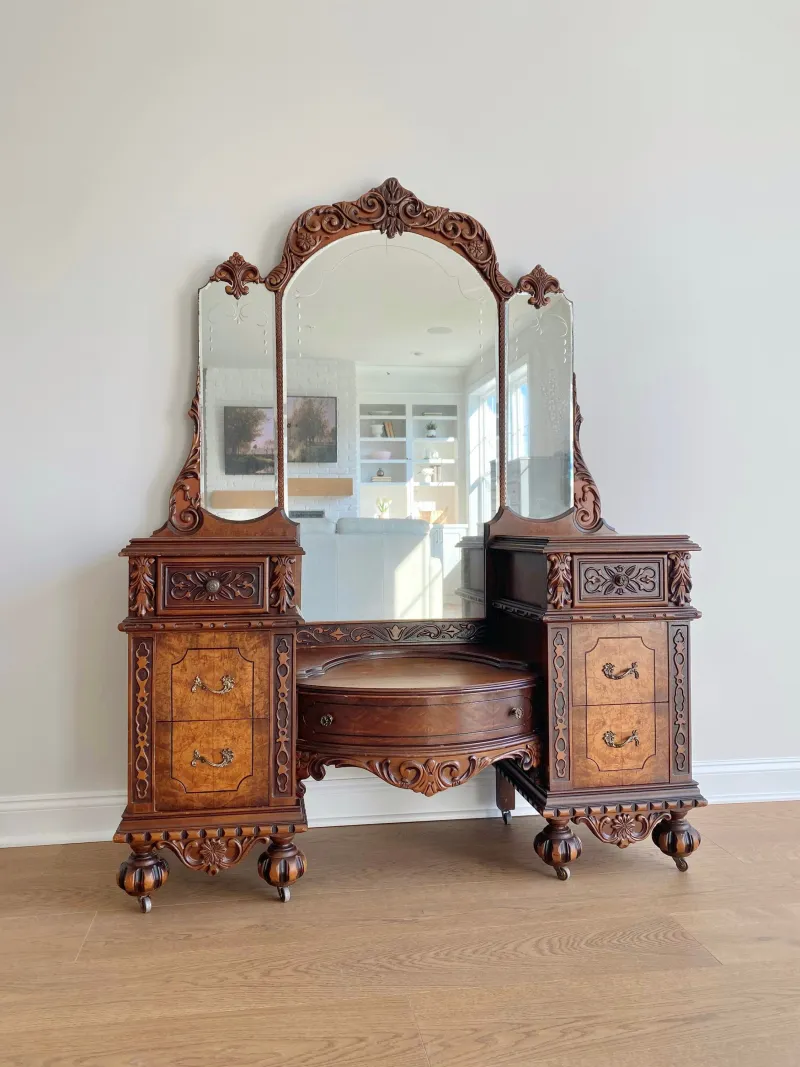
Photo: vintage antique vanity mirror with tarnished gold frame on dresser warm light, via i.etsystatic.com
Every single week, without fail, at least a dozen comments land under my vlogs asking the same question: "Where's that mirror from?"
Not the outfit. Not the lip color. The mirror.
It's an oval vanity mirror with a tarnished gold frame that belonged to my grandma for probably fifty years before it belonged to my content. It has a crack in one corner that I've never fixed because honestly? The crack photographs beautifully. And the whole situation has taught me something I didn't expect to learn this year: the stuff you inherit might be the best production design budget you'll ever have.
Why Heirlooms Outperform Everything Else on Camera
Here's my working theory. Most creator setups look identical — the same ring light, the same white desk, the same faux eucalyptus. When something with actual age shows up in frame, it breaks the pattern. Viewers can feel the difference between a prop bought last Tuesday and an object that has lived a life.
An heirloom has patina. Patina is texture. And texture is what makes a camera image look expensive, whether we're talking about a $12 vintage brass candlestick or a $1,200 lens.
There's also the story factor. When I mention on camera that the crocheted blanket draped over my chair was made by hand sometime in the 1970s, the comments light up in a way no haul video ever could. People aren't just watching a vlog anymore — they're inside a home with history in it.
The Field Guide: Where to Source Meaningful Props
You don't need a rich grandmother with excellent taste. You need patience and a strategy. Here's my sourcing playbook:
Start with your own family first. Call your mom. Call your aunts. Ask the question nobody asks: "Do we have stuff in the attic?" Every American family has a box of unlabeled brass, a quilt nobody uses, a lamp that's been unplugged since 1998. Claim it before it hits the curb.
Estate sales, not antique malls. Antique malls mark things up 300%. Estate sales — check EstateSales.net for your area — are where the real deals live, especially on Sunday afternoons when sellers want everything gone. I got a pair of milk-glass vases for $4 total.
Facebook Marketplace is an heirloom goldmine. Search terms like "brass lamp," "vanity set," "vintage mirror," or "grandmother's lot." Older folks downsizing often price beautiful things at yard-sale prices just to see them go to someone who cares.
Church rummage sales and library book sales. Underrated, cheap, and full of the exact mid-century housewares that read "warm and expensive" on camera.
What Actually Reads 'Expensive' in Frame
After two years of trial and error, here's my shortlist of heirloom items that punch way above their weight on camera:
- An aged mirror — any shape, any tarnish. It bounces light and adds depth to even the dullest corner.
- Brass anything — lamps, candlesticks, picture frames. Tarnish included.
- A hand-crocheted or quilted throw — texture close-ups are free B-roll.
- Crystal or cut-glass decanters — fill with flowers, skip the gin.
- Old hardcover books — stack three, done. Instant intellectual warmth.
- Ceramic or porcelain lamps with fabric shades — the warm bulb glow does more for your footage than any preset.
- Wooden trays and small framed vintage photos — background details that reward pause-frame viewers.
A Few Rules I've Learned the Hard Way
First, clean, don't restore. A gentle wipe-down is fine; stripping the patina off that brass is a crime against your own footage.
Second, rotate, don't clutter. I keep about five heirloom pieces in rotation and swap them seasonally. One strong object per shot beats a crowded shelf every time.
Third, and most importantly — use the real stuff. Don't hide great-grandma's teacup in a cabinet because you're scared of breaking it. She bought it to be used. And if your comment section is going to fall in love with your decor anyway, it might as well be decor with a story.
The mirror stays cracked. The blanket stays crocheted. And the comments keep coming — which, if you think about it, is the whole game.