Five Sets, One Tiny Apartment: My Rental-Friendly Guide to Faking a Studio
Photo: Marjory Collins, Public domain, via Wikimedia Commons
People slide into my comments assuming I have a whole content house. I do not. I have 600 square feet of rental apartment, a security deposit I'd very much like back, and a deep, documented hatred of drilling into walls.
And yet, if you watched my last month of uploads back to back, you'd swear I filmed in five different places. A vanity nook. A cozy reading chair. A bright coffee-table zone. A kitchen counter moment. A standing mirror situation.
Here's the truth nobody tells beginner creators: background design beats camera gear. Every time. A $2,000 camera pointed at a sad beige wall still looks sad. A $40 thrifted lamp behind a mid-range phone makes people stop scrolling. Let me walk you through exactly how I built my five setups.
Rule Number One: Chase the Window, Not the Gear
Before you buy anything, spend one full day tracking light. Seriously — set an alarm every two hours and snap a photo of every room in your apartment. You're looking for soft, indirect light: north-facing windows, or east-facing windows that glow in the morning.
My best 'set' cost zero dollars. It's a wooden chair I dragged in front of my bedroom window, angled about three feet off the glass so the light wraps instead of blasts. That's it. That's the set. I've filmed sponsored content, lookbook intros, and half my talking-head vlogs in that chair.
If your light is harsh, hang a cheap white sheer curtain ($8 at Target) and boom — instant diffusion. If you film at night, one ring light bounced off a white wall beats one ring light pointed at your face. Physics is free.
Set 1: The Vanity Corner (The 'Beauty & Chat' Zone)
My vanity is actually a thrifted mid-century dresser I found on Facebook Marketplace for $60. On top: a mirror with built-in bulbs (IKEA, under $30), a small lamp for warm fill at night, and a tray of 'set dressing' — perfume bottles, a jewelry dish, a candle I never light because continuity errors are real.
The trick: keep the background behind you styled, not the surface in front of you. Viewers don't see your keyboard; they see the wall over your shoulder. Mine has a peel-and-stick arch mirror, a framed print from a local art fair, and a hanging plant. All renter-safe, all removable.
Set 2: The Flat Lay Zone (Coffee Table Edition)
Every creator needs a top-down spot for hauls, unboxings, and 'what's in my bag' videos. Mine is a coffee table pushed flush against a window wall, filmed from above with a cheap phone mount that clamps to a curtain rod (renter-safe, I promise).
The surface matters more than the table. I rotate three backgrounds: a white foam board, a linen throw blanket, and a wooden butcher block. Total investment: about $25. The butcher block alone has appeared in probably 40 videos.
Set 3: The Window Chair (Already Covered — It's That Good)
Yes, it deserves its own number. Add a throw blanket and a book you'll never read, and the shot sells itself. Morning light only. This is where I film anything vulnerable or story-time adjacent. Soft light for soft subjects.
Set 4: The Kitchen Counter
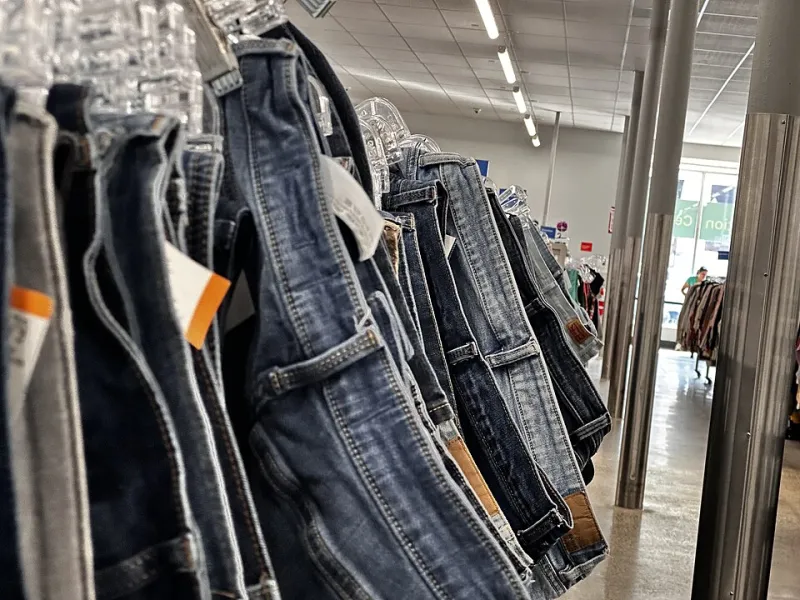
Apartment kitchens are usually the ugliest room, so I cheat. I film above the counter, never showing the cabinets. A cutting board, a linen towel, a mug, and suddenly it's a 'morning routine' scene. Thrift stores are undefeated for character mugs and vintage glassware — I've never paid more than $4 for a prop.
Set 5: The Mirror Moment
A full-length leaning mirror (no wall damage) against my cleanest wall, with a lamp behind the camera and the closet door open just enough to show a sliver of hanging clothes. It reads 'styled bedroom' without me styling a bedroom.
Where I Actually Get Props
- Goodwill and Salvation Army: lamps, vases, books, glassware
- Facebook Marketplace: furniture that photographs like it costs 10x more
- Dollar Tree: fake eucalyptus, trays, candle holders
- Estate sales: the secret weapon. Vintage everything, priced to move
The Real Takeaway
You don't need a studio. You need five corners with intentional light, one or two styled backgrounds, and the willingness to move a chair around your apartment like a set dresser on a deadline. The camera is the least important thing in the room.
Now go move some furniture.